an expressive response to the topics explored

Monday, June 14, 2010
Making the familiar strange...
('Malice in Wonderland' 2009, online video, retrieved 14 June 2010 from, http://www.youtube.com/watch?v=Pa7rmkfCcf0)

If I were an Ethnographer...
I see Nimbin as one of the most cultured places I have ever visited. After reading about the Ethnography, it was one of the first places that came to mind if i were to study a particular group and their environment. Nimbin is known for its laid back and alternative lifestyle. On nimbinaustralia.com it is refered to as the 'alternative capital of Australia'. Nimbin has its own distinct environment, although it is in close proximity to more 'familiar' places, the people there have different lives and all share the similar views. Nimbin even has its own 'rules' which are pictured below.
Nimbin is also heavily associated with marijuana use with their well known annual 'Mardigrass' festival and Hemp embassy.
In the textbook, Katrina Schlunke explains that ethnography is about getting a detailed understanding of the very particular culture (the ordinary lives, contested codes and representations) of the participants that are studied (2008: 219).
When I visited Nimbin, about a year ago i have continued to wonder about the lifestyles of the people who live there, their daily rituals and beliefs - the reason why they live there. There is obviously a lot to be uncovered about this place.

A sign outside a shop in the main street of Nimbin, expressive of the lifestyle Nimbin residents live.
(Retrieved 14 June 2010 from, http://aphs.worldnomads.com/blue_skies/11377/IMG_0250.jpg)

A shop sign reflective of Nimbin's drug culture
(Retrieved 14 June 2010 from, http://a54.ac-images.myspacecdn.com/images01/22/l_05eb919ad99d11b1030bff0e7213347d.jpg)

The Nimbin rules
(Retrieved 14 June 2010 from, http://images.travelpod.com/users/hudsondino/durham2oz.1197692520.nimbin-rules.jpg)
Nimbin is also heavily associated with marijuana use with their well known annual 'Mardigrass' festival and Hemp embassy.
In the textbook, Katrina Schlunke explains that ethnography is about getting a detailed understanding of the very particular culture (the ordinary lives, contested codes and representations) of the participants that are studied (2008: 219).
When I visited Nimbin, about a year ago i have continued to wonder about the lifestyles of the people who live there, their daily rituals and beliefs - the reason why they live there. There is obviously a lot to be uncovered about this place.
A sign outside a shop in the main street of Nimbin, expressive of the lifestyle Nimbin residents live.
(Retrieved 14 June 2010 from, http://aphs.worldnomads.com/blue_skies/11377/IMG_0250.jpg)
A shop sign reflective of Nimbin's drug culture
(Retrieved 14 June 2010 from, http://a54.ac-images.myspacecdn.com/images01/22/l_05eb919ad99d11b1030bff0e7213347d.jpg)
The Nimbin rules
(Retrieved 14 June 2010 from, http://images.travelpod.com/users/hudsondino/durham2oz.1197692520.nimbin-rules.jpg)
Pastiche

(Retrieved 14 June 2010 from, http://img1.tvloop.com/img/showpics/8b/76/l33f36ecc0000_2_29151.jpg)
(Retrieved 14 June 2010 from, http://www.sjsu.edu/faculty/wooda/171/Salvador.jpg)
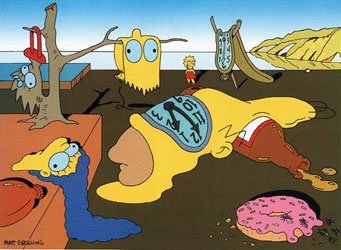
Both of the images from 'The Simpsons' above are examples of the postmodern technique called pastiche. Pastiche makes play of already familiar texts and recreates them, almost making fun of them. The first image is in reference to Nirvana's 'Nevermind' album cover and the second resembles the well known painting 'The Persistence of Memory' by Salvador Dali. The images have been changed into a Simpsons context, using the familiar characters and objects associated with The Simpsons, yet it is still obvious which text is being represented.
There are no universal truths...
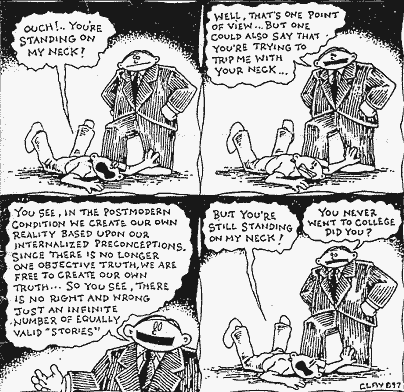
The following two images make jokes in reference to the postmodern idea that there is not one single truth.
(Retrieved 14 June 2010 from, http://www.adidaupclose.org/FAQs/postmodern.gif)

(Retrieved June 14 2010 from, http://churchmousec.files.wordpress.com/2009/08/postmodernism-sbcimpactnet.jpg?w=400&h=320)
(Retrieved 14 June 2010 from, http://www.adidaupclose.org/FAQs/postmodern.gif)
(Retrieved June 14 2010 from, http://churchmousec.files.wordpress.com/2009/08/postmodernism-sbcimpactnet.jpg?w=400&h=320)
Mind/ Body Opposition

(Retrieved 14 June 2010 from, http://28.media.tumblr.com/tumblr_kzp4dvHLbe1qagmepo1_500.jpg)
Although this image is a brain vs. heart comparison rather than mind vs. body i still feel it reflects similar ideas of binary opposition and the way it constructs our way of thinking. As Derrida says, there is always one opposition privileged over the other, in the case of this image, the brain is privileged. It also presents another opposition between chaos and order.
Friday, June 11, 2010
Same song, different meaning
(Whitley 2008, 'Dancing Queen on Triple J like a version', online video, retrieved 11 June 2010, from http://www.youtube.com/watch?v=frI8q2GLZI4&feature=player_embedded)
This cover version of the Abba song 'Dancing Queen' shows how voice and music are a separate text. In Chapter 7, Schlunke says that "certain voices combined with music or memory or both may render us ecstatic, morbid or formless" (2008: 265).
Although the Whitley version of the song uses the same lyrics and melody, the aesthetics are completely different. The lyrics seem more meaningful as many aspects of the song have changed. The more upbeat, pop sound of Abba has been replaced with a slow and softer sound. Whitley's voice in particular is very soft and calm. Theo Van Leeuwen discusses how voice level evokes certain feelings. A softer voice is considered to be more intimate, which is why Whitley's version feels like the story in the lyrics are more meaningful.
Thursday, June 10, 2010
performative sexuality?

(Sacha Baron Cohen as Bruno 2009, retrieved 10 June 2010 from, http://images.smh.com.au/ftsmh/ffximage/2009/07/09/300bruno_review_090709095250815_wideweb__300x402.jpg)
In the chapter on sex and sexuality, the concept of heterosexuality is explored. It discusses how heterosexuality is a learned behavior. If this is so, what about homosexuality? I feel as though most of these ideas about heterosexuality can be applied to homosexuality. This subject is touched on later in the chapter. Schlunke says that "to have gay liberation one needed to 'discover' an original gay identity that could only be identified by limiting what gay could mean".
I often notice that people assume that others are gay based purely on the way the individual acts. This goes to show that we truly do have ways of behavior that are considered normal for a heterosexual. Particular activities, ways of dress, of social behaviour are associated with being gay. I have recently been involved in a theatre production and I will admit that it was automatically assumed that all the male cast members were gay. Majority were, but the few that weren't are all constantly stereotyped as gay. It is interesting to think that along with sexual preferences there are expectations of how someone should act. We are not only performative of our gender, as Judith Butler suggests, but also of our sexual orientation.
Subscribe to:
Posts (Atom)